Why AI Workflows Matter More Than AI Tools for Business Growth
You have probably already used AI this month: a draft written faster, an email cleaned up, a translation checked. And yet nothing about how your business runs has changed. Enquiries still wait for you personally. Follow-ups still depend on your memory. Quiet evenings still mean silent customers.
That gap has a name, and the numbers draw it sharply. In the U.S. Chamber of Commerce's 2026 report, 89% of small businesses said they use AI in some form. But the U.S. Census Bureau's business survey, which asks the stricter question of whether AI is actually used to produce goods or services, finds under one business in five. Nearly everyone touches the tools. Few run them as systems. This post explains the difference between an AI tool and an AI workflow, why the workflow is the version that grows a business, and how to spot your own first workflow this week. We build these for clients and run them on our own site, so the examples below are working machinery, not theory.
A tool helps you work. A workflow works without you.
An AI tool is something you open, use, and close: a chat assistant, a transcriber, an image generator. It makes a task faster, but the task still starts and ends with you. Skip a day, and the work skips a day with you.
An AI workflow is a chain that runs on a trigger instead of on your attention: when X happens, do these steps, then hand the result to a person or the next step. When an enquiry arrives, read it, categorize it, send the right acknowledgment, notify the right teammate, log it in the CRM. Nobody opened anything. Nothing depended on someone remembering.
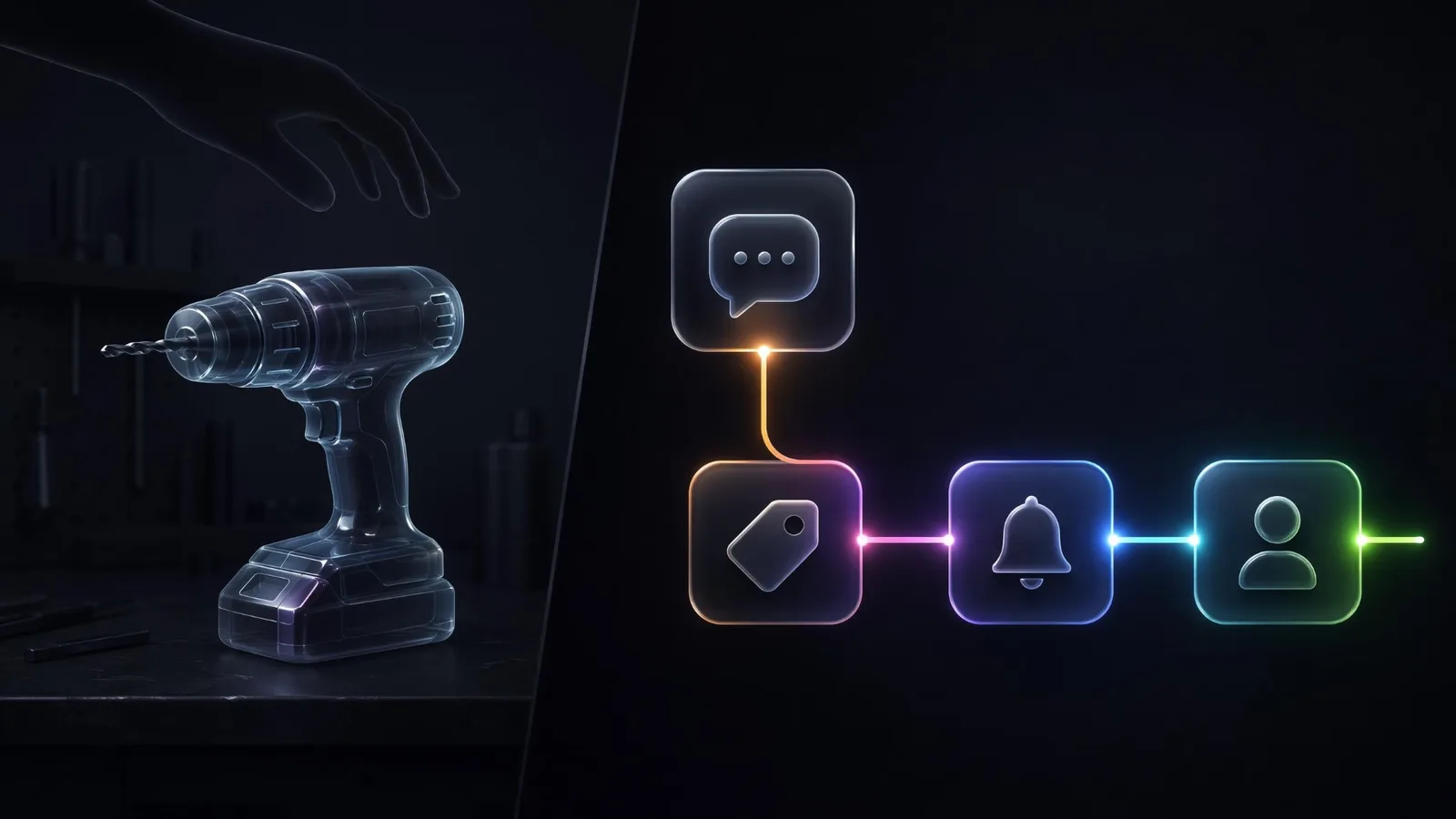
The house analogy makes the difference physical. AI tools are power tools in the garage: excellent, but only when someone picks them up. A workflow is the smart home system: the lights that switch on when someone enters, whether or not you are home. Nobody calls a drill a smart home, and a subscription to a chat assistant is not an automated business.
The test is one question: if you ignored your business for 48 hours, what would still happen correctly? Everything in that answer is a workflow. Everything else is a tool waiting for your hands.
Why workflows change growth, not just speed
Tools save minutes. Workflows remove ceilings. The distinction matters because most service businesses do not stall from lack of demand; they stall because every process routes through the owner's attention, and the owner has the same 24 hours as everyone else. More marketing just makes the queue in front of you longer.
Workflows attack that ceiling in three specific ways:
- They make response instant, at any hour. A workflow that reads a form submission, sends an honest acknowledgment, and alerts your phone reduces first-response time from "whenever you next check" to seconds. For the customer, that speed is the first impression of your professionalism.
- They make consistency free. A human doing the same intake step forty times does it well thirty-five times. A workflow does it identically every time, including the Friday evening of a hard week. Consistency is what customers experience as reliability, and reliability is what they recommend.
- They make delegation possible before hiring. The step-by-step logic a workflow needs is the same documentation a future employee needs. Businesses that automate their intake often discover they have accidentally written their first operations manual. A smart business does not depend on memory. It depends on systems.
None of this requires the AI to be brilliant. Most valuable workflows use AI for modest, boring judgments: what is this message about, which category does it belong to, does this need a human now or tomorrow. Boring judgments, applied instantly and every time, beat impressive ones applied occasionally.
Where workflows fit a service business first
The highest-value territory is almost always the path between "a customer wants something" and "a human is working on it," because that path runs outside business hours and leaks silently. Typical first workflows: enquiry intake and routing, instant acknowledgments with honest response promises, appointment reminders that cut no-shows, and follow-up nudges to enquiries that went quiet. That intake-to-follow-up chain is the operational heart of a client acquisition system, and wiring it end to end is the core of our automation work.
One honest boundary, and it is a hard one: a workflow should never pretend to be a person. An automated reply that says what it is ("your message arrived, a human answers within the hour") builds trust. A bot performing as a human builds a small deception into the first minute of the relationship, and customers rarely forgive discovering it. Automate the plumbing, never the pretending.
And some things stay human on purpose: pricing judgment calls, apologies when something went wrong, negotiations, anything where the customer needs to feel weighed rather than processed. A workflow's job is to deliver those moments to you faster and with better context, not to take them over.
How to find your first workflow this week
Do not start from what AI can do. Start from where your attention leaks. This exercise takes one evening:
- List every repeating touchpoint between customers and your business: enquiries, bookings, reminders, follow-ups, invoices, reviews.
- Mark the ones that wait for you personally. Be honest; "my assistant checks it" still counts if it waits for one specific person.
- Circle the ones where waiting costs money. An enquiry cooling overnight costs more than a slow invoice.
- Pick exactly one. Write its steps as if teaching a new employee: when this arrives, check this, then send that, then tell this person.
- That written page is your first workflow specification. Whether you or someone like us wires it up, the thinking is done.
If you want the broader menu of what is worth automating, and what is not worth automating yet, that deserves its own article and we wrote one: which AI automations are worth building first.
Quick checklist
Before deciding your business "already uses AI," confirm that:
- You can name what happens to an enquiry that arrives at 10 p.m., step by step
- At least one customer-facing process runs on a trigger, not on your memory
- Automated replies say what they are; nothing performs as a fake human
- The steps of your most repeated process are written down somewhere
- You know which single process costs the most when it waits for you
- Money moments and apologies still reach a real person, with context attached
- If you disappeared for 48 hours, new customers would still be greeted
Want a second pair of eyes on this? Book a free 20-minute call. No pitch, just a clear look at which of your processes would repay automation first.
Too busy for a call right now? Send us your project through the contact form. It is already prefilled for this topic, so it takes two minutes. Or message us directly on WhatsApp. Either way, you get a concrete answer within 24 hours.