Spreadsheet CRM: The Moment It Starts Costing You Clients (And What to Do)
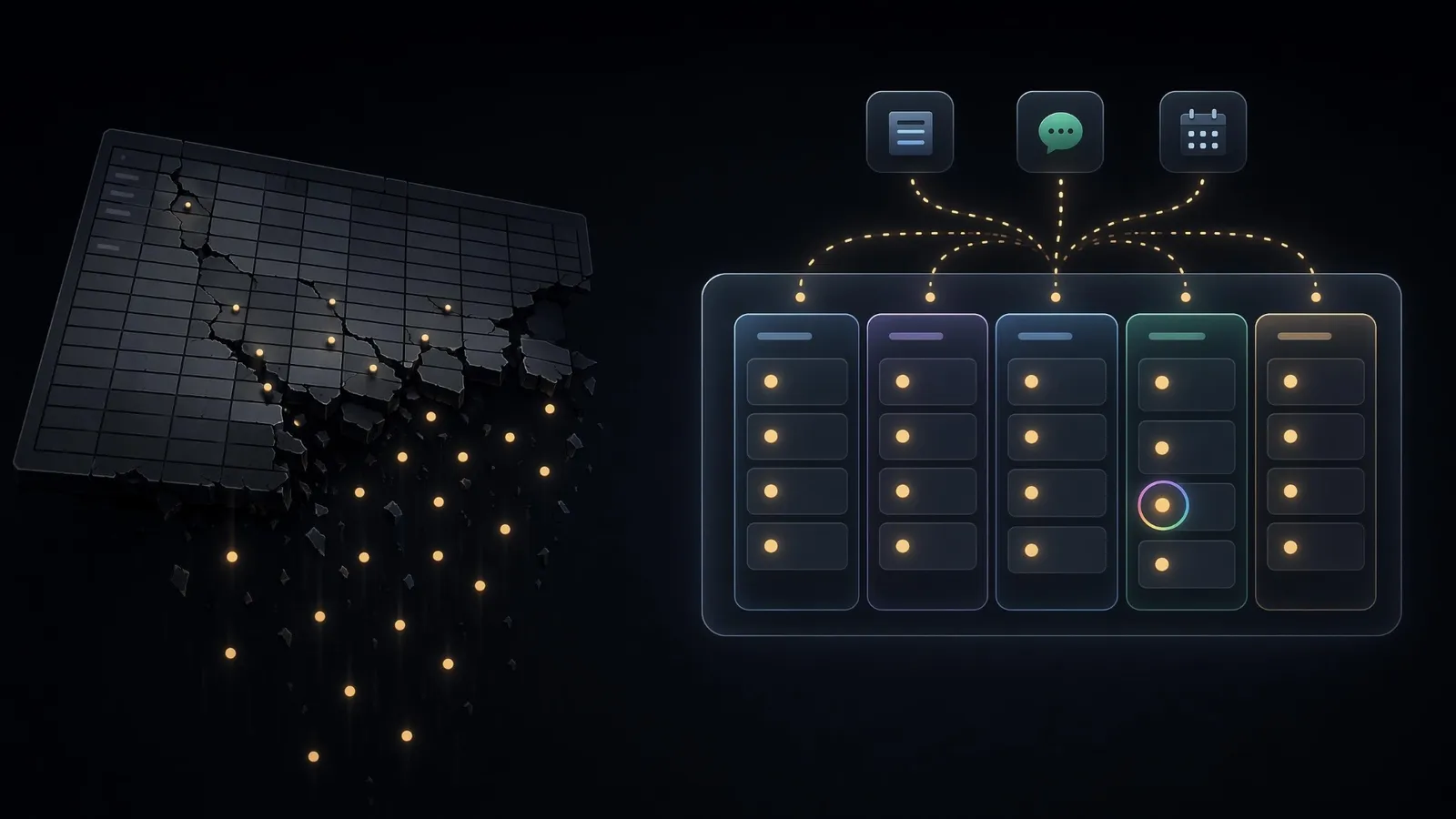
Nobody loses leads on purpose. They lose them in the gaps: the WhatsApp enquiry never copied into the spreadsheet, the follow-up scheduled in your head, the "let me check and get back to you" that nobody got back to. Your spreadsheet did not fail; the spaces between your spreadsheet, your inbox, and your chat apps did.
This post gives you the five signs that gap-management has started costing you actual clients, what a small-business CRM genuinely needs (and the enterprise features you would be paying for and never touching), and how auto-capture removes the retyping that kills every manual system. The CRM we build for clients grew out of running our own pipeline, so this is written from inside the problem.
The five signs you have outgrown the spreadsheet
Any one of these occasionally is life. Two or more of them weekly is a leak with a price tag:
- You remembered a follow-up in the shower. Your pipeline lives partially in your memory, and memory does not scale past a handful of open conversations.
- Someone got contacted twice, or nobody contacted them at all. Classic gap symptom: the lead existed in two places and was owned in none.
- "Where did that lead come from?" has no answer. Without source tracking you cannot know whether ads, referrals, or Instagram feed you, so marketing budget is allocated by feeling.
- A hot lead surfaced three weeks late. You found the message eventually, under 40 newer ones. The lead found a competitor faster.
- You cannot see your pipeline in one glance. How many open conversations, at which stage, worth roughly how much? If assembling that answer takes an evening, decision-making runs blind.
The spreadsheet itself is innocent. It is a ledger, and you are asking it to be a dispatcher, a calendar, and an alarm clock.
What a small-business CRM actually needs (short list)
CRM shopping fails in two directions: staying on the spreadsheet too long, or buying an enterprise system whose setup swallows a quarter. The genuinely needed list is short:
- One record per lead with contact details, source, and the full conversation history in one place.
- A visual pipeline: New, Contacted, Quoted, Won, Lost. Five columns; resist the urge to invent twelve.
- Follow-up dates with reminders, so the system remembers instead of your shower.
- Notes where the context lives, so "the client with the two shops in Bonanjo" is findable by anyone, not just by you.
What you do not need at this size: lead scoring algorithms, territory management, forecast weighting, or 300 integrations. Every unused feature is not neutral; it is friction that stops your team from opening the tool at all, and an unopened CRM is a more expensive spreadsheet.
Auto-capture: the feature that decides everything
Here is the uncomfortable truth about manual CRMs: they decay. Discipline enters the data for two weeks, then a busy Friday happens, and from that day the CRM is a museum of your pipeline as it looked in March.
The fix is removing the typing. Auto-capture means your website form creates the lead record itself, a booking arrives with service and budget already attached, and a WhatsApp enquiry lands in the same pipeline without anyone copying anything. The human job shrinks to updating stages and writing notes, which is small enough to survive busy Fridays.
This wiring, forms plus booking plus WhatsApp flowing into one pipeline, is the center of our AI automation systems, and it is the reason a CRM stays alive in year two instead of becoming March's museum.
The revival move: your cold leads are not dead
The first thing to do with a working CRM is not managing new leads; it is mining old ones. Export every lead from the past year that neither bought nor said no, and send one honest, personal message: a short check-in, no pressure, one useful thing. Typical result from a hundred cold leads: a meaningful handful of reopened conversations that cost you an afternoon.
That one exercise routinely pays for the entire CRM project, and it is only possible because the leads were captured somewhere instead of scattered. The systematic version of it, sequences that follow up without you, is covered in the four automations worth building, and the front door of the whole pipeline, appointments that book themselves, in the case for online booking.
Your ten-minute audit
Open last month's enquiries across every channel: inbox, WhatsApp, forms, DMs. Count them, then count how many got a reply within a day, and how many ever got a second touch. Those three numbers are your capture rate, your speed, and your follow-up rate, and one of them will be embarrassing. That one is where the leak is.
Quick checklist
You have outgrown the spreadsheet if:
- you remember follow-ups in the shower instead of the system reminding you
- a lead has been contacted twice, or missed entirely, in the last month
- "where did that lead come from?" has no reliable answer
- a hot lead once surfaced weeks late, under newer messages
- you cannot see your open pipeline and its rough value in one glance
- your website form, bookings, and WhatsApp do not auto-create lead records
- your pipeline has more than about five stages (a sign of over-building)
- you have a year of cold leads nobody has ever revisited
Want the audit done with you? Book a free 20-minute call and bring the numbers. No pitch, just a map of where your leads currently fall and what catching them would change.
Too busy for a call right now? Send us your project through the contact form. It is already prefilled for this topic, so it takes two minutes. Or message us directly on WhatsApp. Either way, you get a concrete answer within 24 hours.