AI Writes Your Content in Seconds. Here's Why It All Sounds the Same (and the Fix)
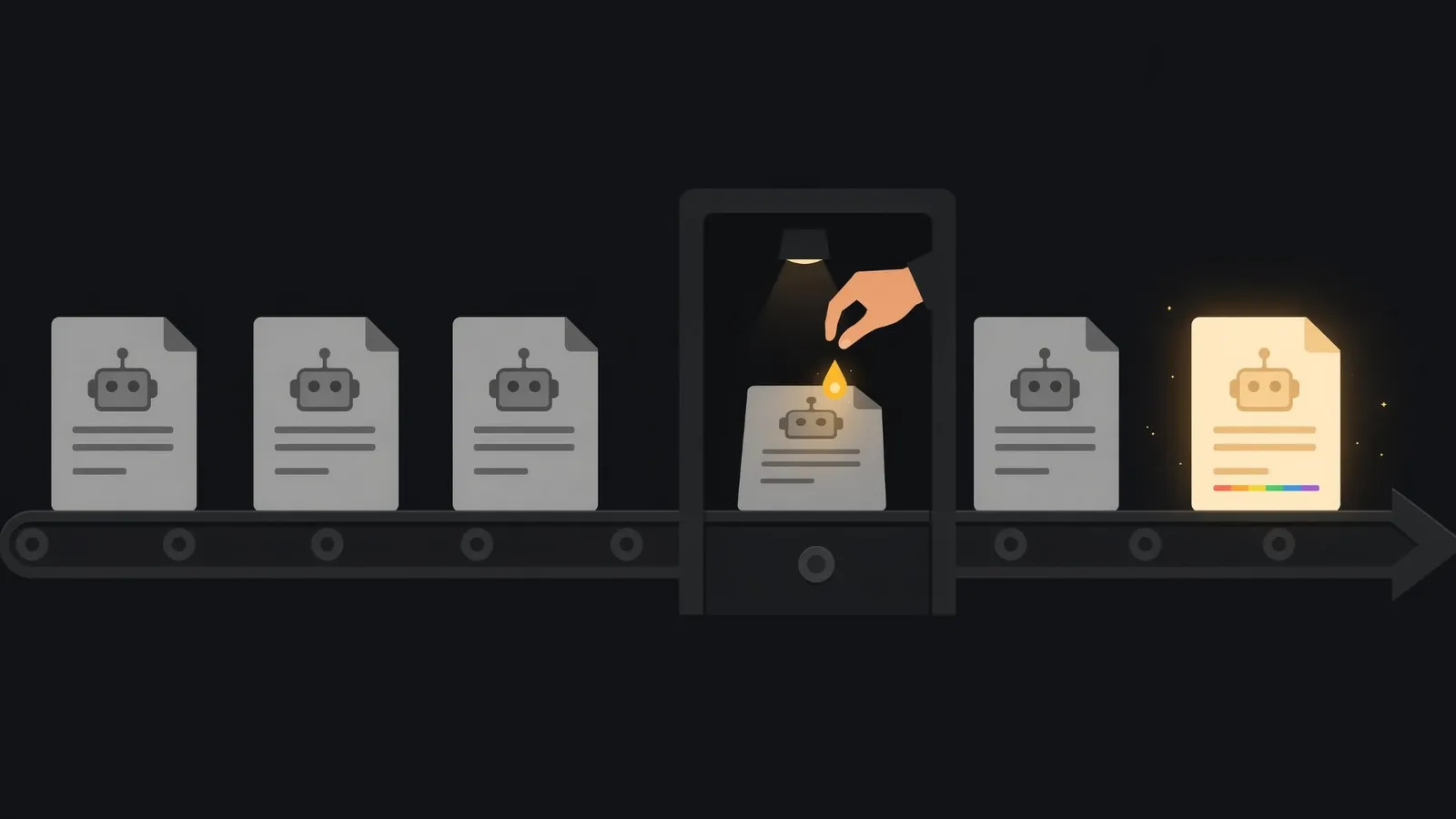
Among small businesses using AI, writing and content generation is the number one use case: about 71% of adopters use it for exactly that, according to 2026 adoption surveys. Meanwhile "chatgpt" sits at the top of all Google searches, with Ahrefs measuring nearly 95 million US searches a month. The tool is universal now. Which quietly destroys the advantage: when most of your competitors use the same writer, that writer stops differentiating anyone.
You have probably felt the symptom while scrolling: post after post with the same rhythm, the same "in today's fast-paced world" openings, the same tidy little conclusions. This post explains why AI text converges, gives you the voice-first workflow that produces content only your business could publish, and names the places where AI writing actively damages trust. We use AI heavily in our own execution, which is exactly why we can describe the line between using it and being replaced by its averages.
Why all AI content sounds the same (it is not a bug)
A language model is, by design, a machine for producing the most statistically likely next words. Ask it for "a blog post about why websites matter" and it delivers the average of everything ever written on that topic: competent, smooth, and interchangeable. That is not a flaw to be patched; it is the physics of the tool.
The convergence gets worse socially: everyone prompts with the same vague requests, so everyone receives variations of the same average. The result is a growing ocean of content that is grammatically perfect and completely unattributable. Readers cannot say what is wrong with it; they just stop reading, and increasingly they can smell it in the first two sentences.
Here is the reframe that fixes everything downstream: the model has no experiences, no clients, no opinions, and no scars. Whatever those things appear in your content, they came from a human. Your job is to be the supplier of exactly those ingredients.
The voice-first workflow
The fix is not better adjectives in your prompt. It is changing what you feed the machine. The workflow:
Step 1: You supply the substance. Before any AI touches the piece, write rough notes answering three questions: What have I actually seen about this topic in my work? (A client story, a number, a mistake.) What do I believe about it that others in my field would argue with? What would I tell one specific client across a table? Voice notes work fine; ugly is fine. This is the part that cannot be generated, and it takes ten minutes.
Step 2: Build a voice brief once, reuse forever. A half page that travels with every prompt: who you are, who you write for, five phrases you actually say, five words you never use, and two examples of your writing you like. Feeding this with every request is the single highest-return AI habit a business can adopt.
Step 3: Let AI do the labor. Structure, drafting from YOUR notes, shortening, translating registers, generating variants. This is where the tool is genuinely superb, and where the hours are saved.
Step 4: You do the judgment pass. Read aloud, cut every sentence you would never say, check every fact (models state falsehoods with perfect confidence), and add the one detail that proves a human was here. If a paragraph could sit on a competitor's site unchanged, it is not done.
The division of labor in one line: humans supply experience and opinion, AI supplies speed and structure, humans supply the final judgment. Remove any of the three and the output shows it.
Where AI content actively hurts
Some surfaces punish generated text disproportionately, and knowing them saves you from the expensive lessons:
- Your About page and personal story. Readers come there specifically to meet a human; the averaged voice is a broken promise on that page above all.
- Testimonials and case studies. Never generate, polish lightly at most. Fabricated proof is not a style problem; it is a trust bomb with a timer.
- Anything with facts, prices, or legal weight. Models hallucinate specifics fluently. Every number gets verified by a human, every time.
- Responses to upset customers. The moment demands presence, and generated empathy reads exactly like what it is.
The same boundary logic applies across your operation, and it is the boundary we draw in what's worth automating and what is not: repetition automates well, judgment does not.
The compounding payoff
Here is the encouraging arithmetic: as generic AI content floods every market, distinctive human-flavored content rises in relative value. The businesses feeding real experience through the voice-first workflow get the speed of AI and the differentiation of authorship, while competitors publish the average faster and faster. This holds for AI search too: answer engines increasingly cite sources with specific, verifiable substance, exactly the ingredient the workflow forces you to include. For the strategic backdrop on making AI work FOR the business rather than instead of it, see why AI workflows are essential for growth.
Content with a voice starts at the website that carries it: the words on your pages are part of every website we build, written to sound like you, because a beautiful site with averaged words is a suit with no one inside.
The ten-minute test
Take your most recent AI-assisted post and mark every sentence that could appear, unchanged, on a competitor's site. If more than half qualify, you have been publishing the average. Run the same piece back through the workflow above, starting with your ten minutes of notes, and compare what comes out.
Quick checklist
Before you publish AI-assisted content, confirm that:
- you supplied real substance first (a client story, a number, a mistake, an opinion)
- a reusable voice brief travelled with the prompt (your phrases, your banned words)
- AI did the labor (structure, drafting from your notes), not the thinking
- you read it aloud and cut every sentence you would never say
- every fact, price, and name was verified by a human
- your About page, testimonials, and upset-customer replies were not generated
- fewer than half the sentences could sit unchanged on a competitor's site
- one concrete detail proves a human was in the room
Want your content layer set up with a real voice brief and the workflow installed? Book a free 20-minute call. No pitch, just a look at how your business can use the tool everyone has, in a way nobody else can copy.
Too busy for a call right now? Send us your project through the contact form. It is already prefilled for this topic, so it takes two minutes. Or message us directly on WhatsApp. Either way, you get a concrete answer within 24 hours.