SEO, AEO, and GEO: Why Ranking on Google Isn't Enough Anymore
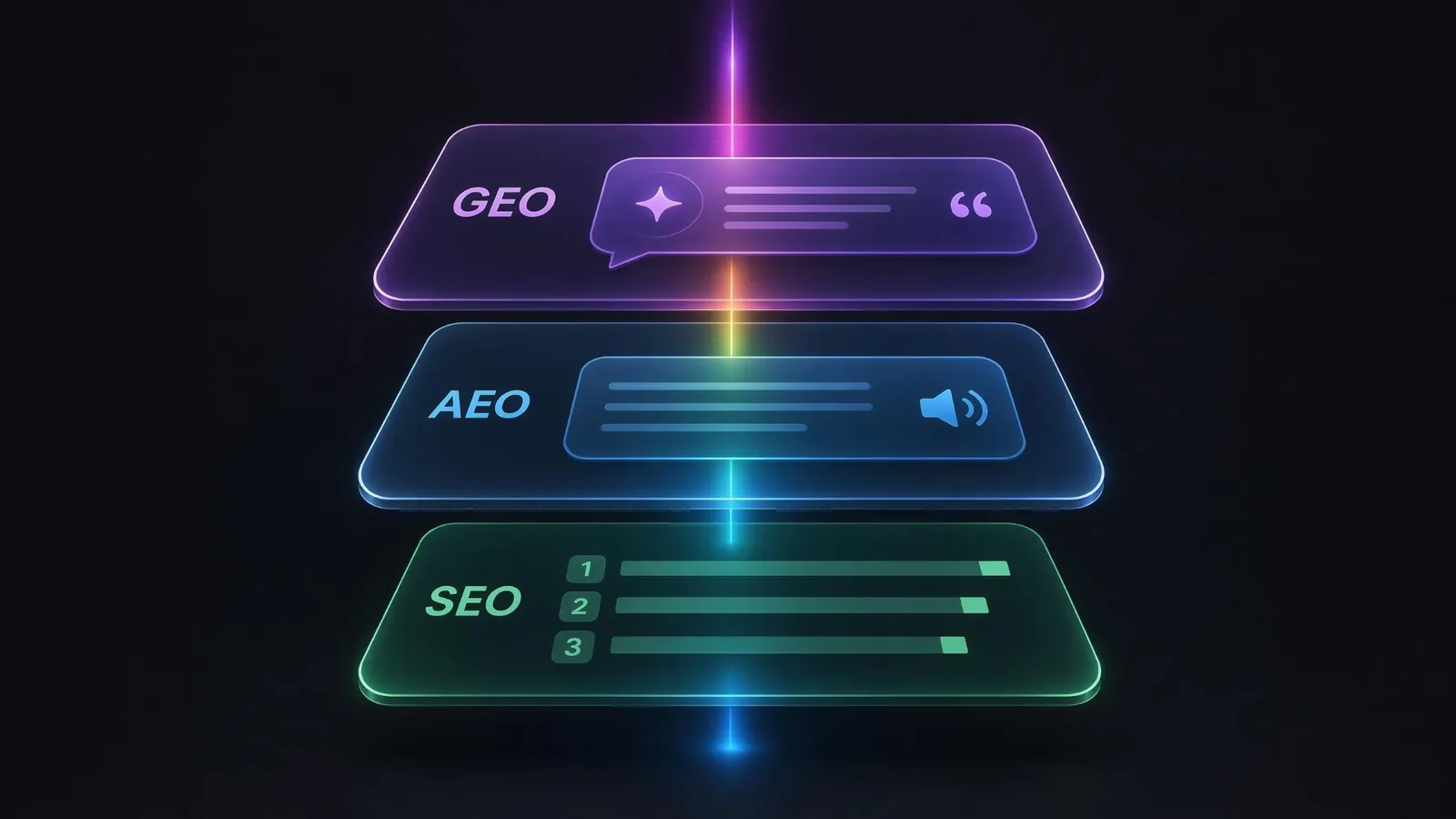
A growing share of your future clients will never see a Google results page. They ask ChatGPT, Perplexity, or a voice assistant, get one synthesized answer, and act on it. If your business is not structured to appear inside that answer, you are invisible in the fastest-growing search channel there is.
This post explains the three layers of search visibility in plain language: SEO, AEO, and GEO. We built all three into our own site, sitemap to schema to llms.txt, so this is a description of a working setup, not theory. By the end you will have a five-point checklist you can run on your own site this afternoon. First, the layer you already know.
SEO still matters (it is the foundation, not the past)
SEO is the discipline of making your pages rank in classic search results, and nothing about AI has made it obsolete. Google still handles billions of queries a day, and AI tools lean heavily on well-ranked, well-structured pages when choosing what to read.
The fundamentals have not changed: pages that load fast, titles and descriptions that match what people search, one clear topic per page, and links from other credible sites. What has changed is that SEO is no longer the whole game. It is the entry ticket. The two newer layers decide who gets quoted, not just who gets listed.
AEO: becoming the answer, not just a result
Answer Engine Optimization targets the answer boxes: featured snippets, "people also ask" panels, and voice assistant responses. One source gets read aloud or shown at the top; everyone else is scenery.
Winning that spot is structural, not magical:
- Answer the question directly, immediately, in the first two sentences under a heading that states the question. Search engines lift exactly these self-contained blocks.
- Use FAQ and structured data (schema.org) so machines know a question-answer pair when they see one.
- One question, one section. A section that wanders across three topics cannot be extracted cleanly, so it never gets picked.
The uncomfortable rule of AEO: write so that a machine could quote any section of your page without needing the rest.
GEO: getting cited inside AI chat answers
Generative Engine Optimization is the newest layer: making your business appear inside the answers that ChatGPT, Perplexity, Claude, and Google's AI Overviews generate. These systems do not rank pages; they extract facts from them and cite the sources they trust.
What makes a site citable:
- Clear, consistent facts. Your name, location, services, prices, and contact details stated identically everywhere. AI systems cross-check; contradictions cost citations.
- Structured data again, but broader: Organization, Service, and article schemas that describe the business in machine-readable form.
- An llms.txt file, a plain-text manifest at yoursite.com/llms.txt that tells AI crawlers what your business is and which pages matter.
- Content with actual substance. Generative engines cite pages that contain specific numbers, comparisons, and answers. Thin marketing pages give them nothing to quote.
This is the exact stack running on the site you are reading, from the schema on every page down to the llms.txt manifest, and building it into client sites is part of every website project we deliver.
The 5-point self-audit (15 minutes)
Run these checks on your own site:
- Google test: search your business name plus your city. Do you control the first three results?
- Snippet test: search your most important customer question. Does any site win an answer box for it, and could your page answer it more directly?
- Schema test: paste your homepage URL into Google's Rich Results Test. Zero detected structured data means the machines are guessing who you are.
- AI test: ask ChatGPT or Perplexity "best [your service] in [your city]". Are you mentioned? Is the information about you correct?
- Manifest test: open yoursite.com/llms.txt and yoursite.com/sitemap.xml. Two 404s mean two missing invitations to the crawlers.
Score honestly. Most business sites pass one of five. Passing four puts you ahead of nearly every competitor, because almost nobody is doing the second and third layers yet. That head start is the whole opportunity: answer engines form their picture of a market early, and the businesses cited first tend to keep getting cited.
Start with the layer that leaks most
If your site fails the Google test, fix classic SEO first; the other layers build on it. If SEO is solid but the schema and AI tests fail, the structured-data layer is your highest-return week of work. And if you pass everything except the AI test, the missing piece is usually content with citable substance, which is exactly why this blog exists.
Quick checklist
Before you assume your site is visible, confirm that:
- you control the first three results for your business name plus city
- your most important customer question is answered directly under a matching heading
- Google's Rich Results Test detects structured data on your homepage
- ChatGPT or Perplexity mentions you, correctly, for "best [your service] in [your city]"
- yoursite.com/sitemap.xml and yoursite.com/llms.txt both load, no 404
- your name, location, services, and prices read identically across every page
- each key page answers one question a machine could quote without the rest
- your pages carry specific numbers or comparisons, not thin marketing copy
Want the audit done for you instead? Send us your URL and book a free 20-minute call. No pitch, just your five scores and what fixing each one would change.
Too busy for a call right now? Send us your project through the contact form. It is already prefilled for this topic, so it takes two minutes. Or message us directly on WhatsApp. Either way, you get a concrete answer within 24 hours.